An LLM-Based Automatic Sportscast Solution for Robot Soccer Matches

RoboCup Symposium 2026

1 Dept. of Computer, Control, and Management Engineering, Sapienza University of Rome  ·  2 Institute for Cognitive Sciences and Technologies (ISTC-CNR), National Research Council, Italy  ·  3 Dept. of International Humanities and Social Sciences, International University of Rome

Video

Abstract

RoboCup has always been a scenario to develop systems that solve real-world problems. Driven by the main goal of playing against the 2050 FIFA World Cup champions, the RoboCup Soccer leagues need to constantly measure how the research community is progressing. Computing visual statistics from match videos is a crucial way to track this evolution. To address this challenge, this paper introduces a fully autonomous, real-time sports commentator for RoboCup matches. By bridging the gap between raw kinematic tracking and natural language generation, our neuro-symbolic architecture extracts precise statistics from video streams and turns them into fluent, hallucination-free narration. The proposed system is capable of generating statistics and commentary both during live match streaming and in post-game analysis, easily adapting to the new dynamism of the league where different humanoid robots of different sizes share the field.

Architecture

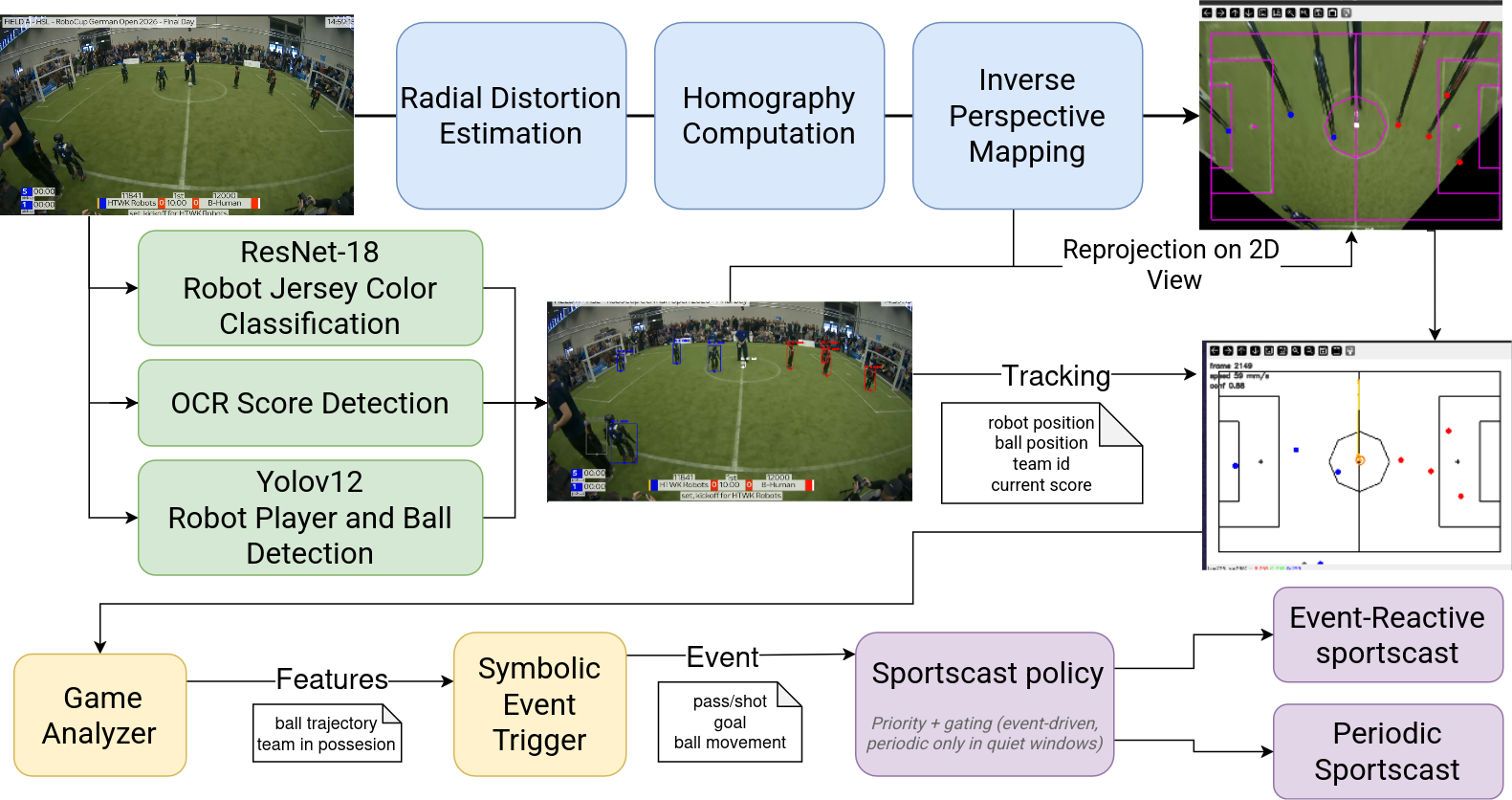
MARIO system architecture diagram

The pipeline is organized around three core components:

  • Calibrator Module: Estimates radial distortion and computes a homography to map detected robots and the ball from image coordinates onto an undistorted 2D top-down field representation aligned with official field dimensions.
  • Visual Perception Module: Processes each frame with YOLOv12 for robot and ball detection, ResNet-18 for jersey-color team classification, and an OCR branch that reads the on-screen scoreboard for goal confirmation. A semi-automatic labeling workflow — bootstrapped by a foundation VLM and optionally refined by a human — adapts the detectors to new robot morphologies with minimal supervision.
  • Sportscast Policy: A symbolic event extractor converts kinematic features (possession hints, directional intent, ball displacement) into discrete events such as passes, shots, and goals. A rule-aware LLM policy then routes these events through a strict priority and temporal gating system, producing two complementary commentary streams: event-reactive narration triggered by high-priority game actions, and periodic commentary generated during quiet windows to maintain audience engagement — both strictly grounded in the symbolic layer to suppress hallucinations.

BibTeX

@misc{}